Have you ever tried to organise a group trip and ended up spending way more than you planned, just because you picked the wrong sized vehicle?
It happens more than you’d think. Most groups end up paying hundreds of pounds extra simply because they chose the wrong size minibus from the start.
Getting this decision right really does matter.
We’ve helped groups of all sizes find the perfect vehicle for cheap group travel across Hertfordshire and beyond. This guide walks you through everything you need to know about 8-seater and 16-seater minibus hire, covering comfort, luggage space, costs, and driving practicalities in a way that’s easy to follow.
By the end, you’ll know exactly which option puts more money back in your pocket.
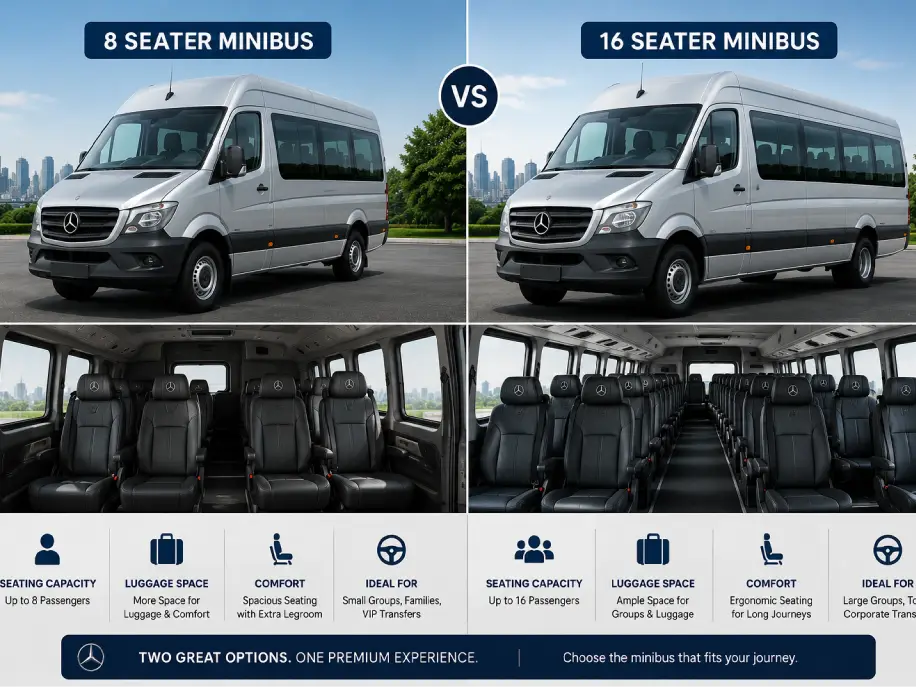
An 8 seater minibus hire in Hertfordshire works brilliantly for smaller groups who want comfort without breaking the bank. You get decent legroom, manageable parking, and a driver who knows the roads from Barking to Chiswick.
An 8-seater minibus is a practical choice for smaller groups heading out on budget-friendly trips. These vehicles pack eight passenger seats plus a driver’s seat into a compact frame, weighing between 2.8 and 3.5 tonnes.
The layout typically features three rows of seating, mirroring the comfort of a large family car. This arrangement makes for a familiar, relaxed ride without the bulk of larger coaches.
Here’s a quick look at what you get with a standard 8-seater:
That Category B licence point is worth pausing on. It means no special training, no expensive upgrade, and no extra paperwork for self-drive options. For groups exploring self-drive minibus hire, this removes a massive stress point entirely.
Fuel bills drop noticeably with an 8-seater, particularly for shorter journeys across Hertfordshire, East London, or trips to Heathrow Airport and Gatwick. The smaller engine uses less petrol, stretching your travel budget further when you’re splitting costs among eight people.
Many 8-seater models come with adjustable or foldable seating, giving you flexibility to create extra luggage space. You can fold down seats for airport transfers, school trips to Brighton, or weekend getaways to the Cotswolds and Windsor Castle. Parking is far less of a headache with this size, as these minibuses fit into standard spaces and handle city streets in Canary Wharf, Chiswick, and Barking with ease.
The 8-seater works brilliantly for specific travel situations. Understanding these scenarios helps you pick the right option for your budget and needs.
It’s a great fit for day trips, local events, and short hops around town:
It also performs well for sporting and social outings:
When your group grows beyond eight people, a 16 seater minibus hire in Hertfordshire becomes your best option for affordable travel. Packing more passengers into one vehicle cuts the cost per person and makes group travel genuinely cheap.
A 16-seater minibus gives you room to breathe, quite literally. You get 16 passenger seats plus space for the driver, totalling 17 occupants in one vehicle. The layout spreads across more rows than smaller vehicles, so passengers enjoy better legroom, headroom, and walking space throughout the cabin.
Wider aisles make it simple for passengers with mobility difficulties to move about, whilst multiple entry and exit points speed up boarding. The vehicle weighs between 3.5 and 4.25 tonnes, so it handles the road well without feeling clunky.
Safety features include seatbelts for every passenger, airbags, and electronic stability control. Reading lights and comfortable armrests make long trips feel less tiring, and the superior air distribution system keeps everyone comfortable, whether you’re heading to Oxford for a day out or catching airport transfers in Hertfordshire. Emergency exits and adequate lighting matter most for evening events or school usage when visibility counts.
The larger cabin distributes air more effectively than cramped alternatives, so you don’t arrive feeling stuffy. Bigger luggage capacity means you can pack suitcases, camping equipment, or bicycles without squeezing everything into overhead compartments.
There’s one important practical point to know about before booking. Based on the latest 2026 DVLA passenger transport regulations, a 16-seater minibus strictly requires a Category D1 driving licence under UK law. Getting a D1 licence is a time-consuming and expensive process, which is exactly why most groups choose a “hire with driver” package. Look specifically for hire packages that include a professional, licensed driver as standard, so you don’t have to worry about licensing at all.
For groups seeking cheap group travel without sacrificing comfort, this seating capacity offers excellent value when you split costs across all passengers.
A 16-seater minibus makes sense when your group grows beyond what a smaller vehicle can handle. Our minibus hire service in Hertfordshire offers a great solution for large parties seeking affordable group travel.
Here are the situations where the 16-seater really earns its place:
We’ve noticed a clear pattern across bookings. Local sports clubs and school organisers with 10 to 14 travellers often start by requesting two smaller cars, then reconsider once they calculate luggage volume and total hire costs. In recent Hertfordshire and West Yorkshire enquiries, groups that switched to a single 16-seater reduced their total vehicle count by half. That decision saves coordination headaches and brings down the per-person expense considerably.
Picking between an 8-seater and a 16-seater involves real trade-offs that shape your entire trip. We’ll break down seating comfort, luggage room, and how each vehicle handles on the road so you can make the right call for your group.
Seating capacity and comfort are two sides of the same coin. The choice between an 8-seater and a 16-seater hinges on how many passengers you’re moving and how long they’ll sit in those seats.
| Factor | 8-Seater Minibus | 16-Seater Minibus |
|---|---|---|
| Passenger Capacity | Holds up to 8 passengers, excluding the driver | Holds up to 16 passengers, excluding the driver |
| Legroom and Headroom | Adequate for short journeys; tighter at full capacity | Enhanced legroom and headroom throughout; preferable for longer trips |
| Walking Space | Limited passage between seats | Wider aisles and easier entry/exit points |
| Comfort on Long Journeys | Passengers may feel confined; limited room to stretch | More space to shift positions and relax; comfort increases significantly |
| Seat Quality Features | Basic seating arrangements | Superior seat quality with reading lights and armrests |
| Climate Control | Temperature controls available; less even distribution | Temperature controls with better air circulation throughout |
| Accessibility | Standard entry points | Wider aisles and multiple entry/exit points; benefits passengers with mobility difficulties |
| Cost Per Passenger | Higher per-person cost for small groups; economical for groups of 6 to 8 | Lower per-person cost for larger groups; best value for 10+ passengers |
Budget matters when you’re gathering your group for a day out or a weekend trip. The 8-seater suits small groups perfectly, think school outings or family reunions under ten people. It’s nimble, quick to hire, and won’t drain your wallet for short distances.
Groups of ten or more discover that the 16-seater spreads costs more fairly. Everyone pays less per head because you’re splitting the rental across more people. According to the 2026 UK Minibus & Coach Hire Pricing Guide by WLMH, a full-day 16-seater hire averages £420 to £580, which works out to roughly £26 to £36 per person when fully occupied. Compare that to booking train tickets or multiple taxis, and the saving becomes very clear.
To put it in perspective with a typical longer journey, take a 200-mile round trip including driver fee and fuel. If the hire costs £220, fuel runs £60, and the driver fee adds £80, the total reaches £360. With 16 passengers splitting that bill, each person pays roughly £22.50. Fill only eight seats, and each passenger contributes £45 instead. That’s a meaningful difference for budget-conscious groups planning anything from sports tournaments to family reunions.
Comfort shifts dramatically over distance. Short hops in an 8-seater feel fine. Your crew gets in, enjoys the ride, and gets out. Nobody complains. Stretch that journey to three or four hours, and people start to fidget. The 16-seater changes everything for lengthy trips, with passengers reporting fewer aches, better moods, and the actual ability to sleep during the journey.
Armrests and reading lights sound like extras, but they’re genuinely practical. They’re standard in a 16-seater. The 8-seater keeps things simple, which works for ninety minutes but struggles beyond that.
Accessibility matters too. Passengers with walking difficulties find the 16-seater’s wider aisles and multiple exit points genuinely helpful. Elderly travellers and people with mobility concerns can board with confidence. The 8-seater’s tighter layout creates real obstacles for them.
Air conditioning performs differently in each vehicle. Both have temperature controls, yet the 16-seater distributes cool air more effectively. In summer, that difference feels substantial.
Your choice comes down to two core questions:
Mixed trips require an honest assessment of your actual needs versus your budget limits. There’s no single right answer, but matching the vehicle to your group size and journey length will always give you the best value.
Luggage space makes or breaks any group travel adventure, especially when you’re trying to keep costs down and fit everyone comfortably.
| Minibus Type | Luggage Capacity | Best For | Cost Impact |
|---|---|---|---|
| 8-Seater Minibus | Holds around 4 to 6 medium-sized bags. Limited boot space at full capacity. Holiday suitcases create tight situations. | Short trips with minimal baggage. Day excursions. Groups of 8 with light packing. | Lower hire cost. No additional vehicle needed for small groups with light bags. Budget-friendly for minimalist travellers. |
| 16-Seater Minibus | Holds 10 to 15 medium 20kg suitcases. Ample room for camping gear and sports equipment. Eliminates the need for additional vehicles. | Camping expeditions. Sporting events. Groups with bicycles or backpacks. Holiday getaways with substantial baggage. | Higher initial hire cost. Saves money by avoiding extra vehicle rental. Better value for large groups with gear. |
| 12-Seater Minibus | Middle ground option. Comfortably holds 10 to 12 passengers with standard luggage. More space than the 8-seater without excess. | Medium-sized groups. Weekend breaks. Trips requiring moderate baggage. | Moderate pricing. Balance between capacity and affordability. Practical for budget-conscious groups. |
Groups often underestimate their luggage needs at the booking stage. You pack heavier than expected, then regret the squeeze. Weekend trips to Hertfordshire airports and nearby destinations illustrate this problem clearly.
Based on 2026 transport fleet specifications from East Coast Coaches, a standard 8-seater boot is typically maxed out at just 4 to 6 medium-sized bags. Once more than three passengers arrive with full suitcases, usable boot space runs out fast. Groups in that situation often need an extra vehicle or rooftop carrier, which can double transport costs and cause real frustration before the holiday even begins.
The 16-seater eliminates that headache completely. It can comfortably hold 10 to 15 medium 20kg suitcases alongside a full passenger load. Camping gear, sports kits, and holiday suitcases all fit without hiring extra transport. That’s a genuine saving for group travel minibus hire.
Boot space represents real money in your pocket. Extra vehicle rental charges add up quickly. A 12-seater offers solid middle ground if your group falls between 10 and 12 passengers with moderate bags.
Your decision should hinge on luggage volume plus passenger count. Light packing with 8 travellers suits the smaller model. Substantial baggage or camping trips demand the 16-seater’s extra room. Always tell the minibus service about your baggage requirements before booking, so there are no nasty surprises on travel day.
Handling the minibus itself matters just as much as the price tag. Parking and driving comfort can make or break your journey, so here’s how these two options compare.
| Factor | 8-Seater Minibus | 16-Seater Minibus |
|---|---|---|
| Weight | 2.8 to 3.5 tonnes. Lighter frame makes steering feel responsive. | 3.5 to 4.25 tonnes. Extra mass requires more physical effort to control. |
| Standard Parking Bays | Fits into regular parking spaces without fuss. Less stress for drivers. | Requires larger spaces. Standard bays often prove too tight. |
| Urban Driving | Excels in narrow streets and tight spaces. City centres become manageable. | Struggles with confined urban areas. Manoeuvring becomes challenging. |
| Rural and Village Settings | Handles small lanes with ease. Country roads feel comfortable. | May struggle without careful planning. Small village settings pose real obstacles. |
| Motorway Performance | Performs well on motorways. Comfortable at speed. | Motorways work fine, but requires more space for lane changes. |
| Driver Experience Level | Easier for less experienced drivers. Confidence builds quickly. | Demands more skill and experience. Steeper learning curve for newcomers. |
| Parking Restrictions | Local council rules often allow standard parking during events. | Many areas impose restrictions on larger vehicles during events or in residential zones. |
| Fuel Efficiency | More fuel efficient, especially on shorter journeys. Budget stretches further. | Consumes more fuel, but becomes economical when fully occupied with all 16 passengers. |
Driver confidence shapes your entire journey. An 8-seater responds like a nimble car, darting through traffic and slotting into parking spaces without drama. Less experienced drivers find this forgiveness invaluable when moving through busy areas.
The 16-seater tells a different story. Its extra weight, ranging from 3.5 to 4.25 tonnes compared to the 8-seater’s 2.8 to 3.5 tonnes, demands real skill. Tight corners become mental puzzles, and parking in standard bays simply won’t happen. You need larger dedicated spaces.
Urban environments clearly favour the smaller option. Narrow streets in city centres open up when you’re in an 8-seater. Small village settings, such as rural Hertfordshire villages or the Cotswolds, can genuinely frustrate 16-seater drivers who face real manoeuvring problems. Motorways suit both sizes, though the larger bus needs more careful lane positioning.
Parking restrictions in residential areas and during events also often target bigger vehicles. Check local council websites before booking. The 8-seater avoids many of these restrictions altogether, saving you stress and potential fines.
Fuel consumption plays into the overall picture too. Short journeys see the 8-seater pull ahead economically. Long trips with a full 16-seater load can reverse this advantage, making per-person costs competitive. Calculate based on your specific route and group size rather than assuming one always wins.
Picking the right minibus comes down to two main things: how many people you’re moving and what you want to spend. Match your group size with the right vehicle, and you get value for money without paying for empty seats.
Your passenger count dictates everything about which minibus you need, so get this right from the start. Use this quick guide to match your group to the right vehicle:
| Group Size | Best Vehicle | Why |
|---|---|---|
| Up to 8 passengers | 8-Seater Minibus | Comfortable, cost-effective, easy to park |
| 9 to 12 passengers | 12-Seater Minibus | Extra space and comfort without overspending |
| 13 to 16 passengers | 16-Seater Minibus | Best per-person value for large groups |
| School trips (16 pupils + 1 teacher) | 16-Seater Minibus | Seats 17 in total, safe and cost-efficient |
A group of six people fits comfortably in an 8-seater, leaving room to breathe and stretch out. Ten passengers, on the other hand, creates a squeeze in an 8-seater and leaves everyone feeling cramped.
Your trip’s purpose shapes the decision too. Wedding parties, birthday celebrations, and football away days all benefit from a 16-seater because your entire group arrives together without splitting into multiple vehicles. This saves money and keeps everyone on the same schedule.
We’ve found that groups travelling on a budget often overlook the cost savings of hiring one larger minibus instead of two smaller ones. Star Coaches and D&G Minibus hire services in North East and Hertfordshire offer competitive rates for 16-seater minibus hire, making group travel affordable. Tell us your group size and luggage details, and we’ll give you an honest vehicle recommendation at no charge.
This straightforward approach means you pay only for what you actually need, not a penny more.
Hiring an 8-seater minibus keeps your wallet happy, especially if your group is smaller. This option costs less upfront, making it perfect for tight budgets. The 16-seater minibus, though pricier overall, actually becomes cheaper per person when you fill all the seats.
Driver time remains the primary expense in both cases. Splitting costs across more passengers makes the larger vehicle sensible for bigger groups. Star Coaches and D&G Minibus offer transparent pricing with no hidden charges, so we can quote both options when you’re uncertain. This helps you make an informed choice based on your actual group size and travel goals.
A few tips to make your booking work harder for your budget:
Both vehicles come with a PSV-licensed and DBS-checked driver included as standard; self-drive hire isn’t available. Our minibus hire in Hertfordshire and across the region ensures you get professional service without extra costs creeping in.
Fuel consumption and operational expenses are higher for larger vehicles, yet the per-person savings often outweigh these factors when your group is substantial. We’ll help you calculate the real cost difference so you can pick the option that genuinely suits your budget and travel needs.
An 8 seater suits small groups of up to 8 passengers, while we find a 16 seater minibus hire in Hertfordshire works better for larger parties who want to travel together without splitting into separate vehicles.
It depends on your group size. If you’re heading to Royal Ascot with a big crowd, a 16 seater keeps everyone together and saves you money on transport costs.
Yes, but we always confirm vehicle compliance when you book with us, as not all minibuses meet ULEZ standards, and driving a non-compliant vehicle into the zone incurs a £12.50 daily charge.
Generally, yes. Smaller vehicles cost less to hire, but if your group is large, splitting across two 8 seaters often works out pricier than booking one 16 seater minibus hire in Hertfordshire.


