You know the part of a group plan that always drifts, who drives, who pays, who parks.
For smart recovery groups in Hertfordshire, Minibus Hire Hertfordshire options and online meetings usually beat a convoy of cars.
The latest National Travel Survey results for England found that 34% of households had two or more cars in 2024, which sounds convenient until you try to coordinate arrivals, parking, and drop-offs across a whole group.
This page breaks down when shared minibuses (and cheap minibus hire hertfordshire) make sense, when online SMART Recovery is the better call, and how the Find a Meeting tool reduces wasted journeys.
Groups in Hertfordshire have moved away from “everyone drives themselves” for a simple reason: it rarely survives contact with real life.
When you support adults with complex needs, learning disability, physical health issues, debt pressure, or tenancy issues, travel has to be predictable. That is what shared transport gives you.
You will usually see three practical patterns working well together:
Smart groups in Hertfordshire now use minibuses and shared vehicles because they reduce uncertainty for the people who need stability most.
If your facilitator team is organising travel, start with the legal and safety basics. UK Government guidance says you may be able to drive a minibus with up to 16 passenger seats on a car licence only if specific conditions are met, including: you are 21 or older, you have held your licence for at least 2 years, you drive on a voluntary basis for a non-commercial body, there is no payment “for hire or reward”, and the minibus stays within the relevant weight limits.
That one detail changes your whole approach. If you plan to collect money from passengers (even if it is just to cover running costs), you may need a minibus permit through the Driver and Vehicle Standards Agency.
From a coordination point of view, I have found these steps stop most last-minute transport problems:
If you want a training standard to anchor your volunteer drivers, many UK groups use the Minibus Driver Awareness Scheme (MiDAS). It gives you a shared baseline for safe loading, passenger care, and defensive driving.
Reducing car journeys is one of the fastest ways a community group can cut its travel footprint, because it lowers emissions and congestion at the same time.
It also supports wellbeing. Fewer separate journeys means fewer “will I get there?” moments, which matters for people managing anxiety, addiction recovery, or domestic abuse-related safety planning.
If you want a number you can actually use, the UK Government’s greenhouse gas conversion factors for 2025 list average local bus emissions at 103.85 gCO2e per passenger-km, while a coach comes in at 27.76 gCO2e per passenger-km. Those figures reward one behaviour: fill seats.
Shared journeys cut emissions and save fuel, but only if you avoid half-empty runs and duplicate routes.
| What you change | Why it works | What to do next |
|---|---|---|
| Replace 3 to 6 cars with one shared vehicle | You cut total engine starts, idling, and parking loops | Set one pickup time and one return time, then stick to them |
| Choose a coach or well-used shared vehicle for longer trips | Per passenger emissions drop fast as occupancy rises | For cross-county trips, aim for a minimum headcount before you book |
| Use online meetings for routine check-ins | No travel means no travel emissions | Keep in-person travel for milestones, peer mentoring, or new-starter support |
| Plan around transport hubs | Shorter feeder journeys reduce total miles travelled | Meet near a station or bus corridor where possible, especially in winter |
| Prevent “extra trips” | One forgotten item can trigger a whole extra round journey | Keep a meeting kit in the vehicle (leaflets, pens, starter packs, water) |
A practical rule: if your shared vehicle regularly runs with fewer than half the seats filled, you may be better switching to public transport, or to online sessions for that week.
The money case for shared transport is simple. Multiple cars multiply costs you do not see in the first estimate, fuel, parking, wear, and “lost time” when arrivals drift.
If your group needs a fair way to calculate travel contributions, use a recognised benchmark. HM Revenue and Customs lists an approved mileage allowance rate of 45p per mile for the first 10,000 business miles in a tax year, then 25p per mile after that. Even when your trip is not “business”, those figures help you sense-check what car travel really costs.
Here is a quick way to use that benchmark for planning:
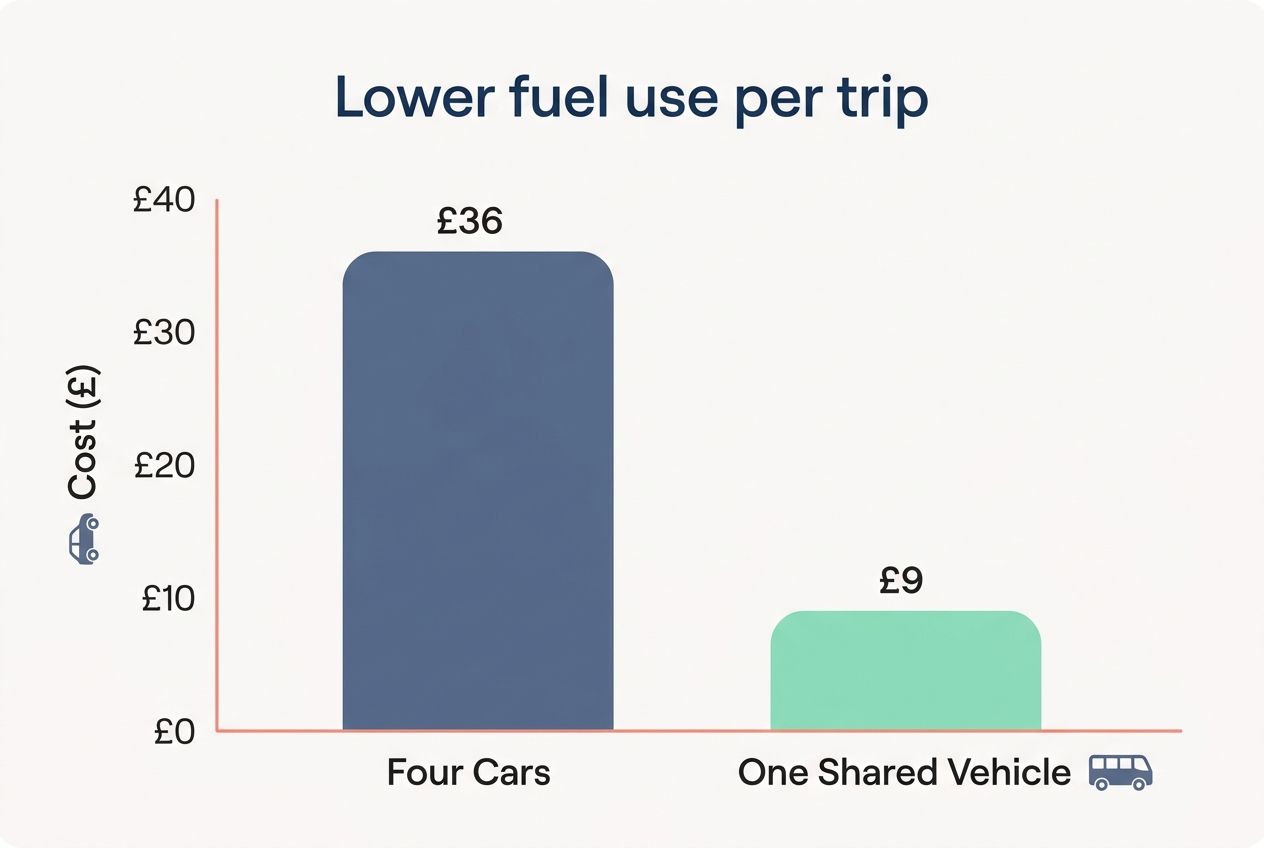
Here are the savings on fuel and maintenance, framed as decisions you can make this week.
| Summary Point | Detail |
|---|---|
| Lower fuel use per trip | If four cars each do a 20-mile round trip, that is 80 miles of driving. One shared vehicle doing the same route is 20 miles. Using the 45p-per-mile benchmark, that shift can change the “true cost” from about £36 to about £9 for the journey. |
| Less wear on personal cars | Shared travel reduces tyre wear, brake wear, and the steady creep of maintenance costs on the same few volunteers. It also protects the people who cannot afford unexpected repairs. |
| More predictable budgeting | HM Revenue and Customs advisory fuel rates (updated from 1 March 2026) can help you sanity check your running costs per mile, especially if your group is reimbursing a driver and you want the approach to feel fair. |
| Lower parking and “arrival friction” costs | Fewer vehicles means fewer parking fees, fewer late arrivals, and fewer people walking alone from a distant car park. That matters for women only groups and anyone managing safety concerns. |
| Cheaper options via planning | Weekly schedules make advance booking possible, which is where cheap minibus hire hertfordshire deals are most likely to appear. The organiser’s job is to lock dates early, then confirm headcount before final payment. |
| Fewer “rules surprises” | A common cost trap is collecting money informally, then discovering the journey counts as “hire or reward”. Decide up front whether you are charging, and if you are, confirm whether you need a minibus permit. |
Shared transport is not just a logistics upgrade. It can be a piece of community inclusion, especially in a county where many people live far from a station and meetings may take place in town centres.
If your group supports people with complex needs, transport can decide whether support is real or theoretical. The NHS service directory describes the Hertfordshire Complex Needs Service (run by Turning Point) as supporting adults aged 18+ in Hertfordshire with mental health needs alongside a range of complex issues, which is exactly the audience that benefits from fewer, simpler journeys.
On the same theme, New Leaf Recovery and Wellbeing College describes its courses as free to Hertfordshire residents aged 18 and over, and Sunnyside Rural Trust runs free community wellbeing sessions. When you align travel planning with those services, you make education and work support easier to reach.
This is where shared travel also supports safeguarding and dignity, especially for survivors of domestic abuse, people in early recovery, and those rebuilding independence.
Travelling together can extend peer mentoring beyond the meeting room, but you need a few ground rules so it stays safe.
Use a simple structure that respects privacy while still building connection:
When you do this well, the vehicle becomes a bridge. It connects SMART Recovery, job club activity, volunteering, and education and work support without asking people to solve transport on their own.
Smart groups in Hertfordshire are moving away from multiple cars because it is expensive, inconsistent, and hard to safeguard.
Shared minibuses, cheap minibus hire hertfordshire options, and public transport planning can keep people together and on time, while online smart recovery meetings and the Find a Meeting tool cut travel to the sessions that matter most.
If you want a simple next step, choose one in-person meeting this month, plan one shared journey, and treat travel as part of the support. That is the real shift behind Minibus Hire Hertfordshire becoming the default.
Smart groups cut car trips to save money, lower emissions and free up parking, and they use shared rides and public transport to link with community outreach projects, the Hertfordshire LEP and the digital innovation zone.
Yes, it makes travel safer and simpler for people with a learning disability and for survivors who use support like watford women’s centre, wellbeing service – sunnyside rural trust and local safe hubs.
The move supports mil-smart and smart veterans schemes, and helps veterans family and friends reach services like start smart and tool time, while keeping military personnel connected to local groups.
Services include hop hertfordshire opportunities portal, community learning partnership (CLP) arts & crafts courses, community learning partnership ltd, free digital skills sessions – hertford, CV writing, interview skills, apprenticeships and student placements, they also offer numeracy skills, multiply and the open award level 2 certificate in peer mentoring.
Yes, shared travel links people to advice on debt, tenancy issues and benefits and welfare issues, and it ties into local help from watford and three rivers trust charity and community alliance broxbourne and east herts.
Yes, groups share practice across England, Scotland, Wales and Northern Ireland and with towns like Hemel Hempstead, South Oxhey, North Hertfordshire district, East Hertfordshire district, Dacorum, Exeter, Plymouth and Sheffield, and this helps tackle substance use issues, offending and anti-social behaviour, addiction, physical health issues and boost community inclusion.


